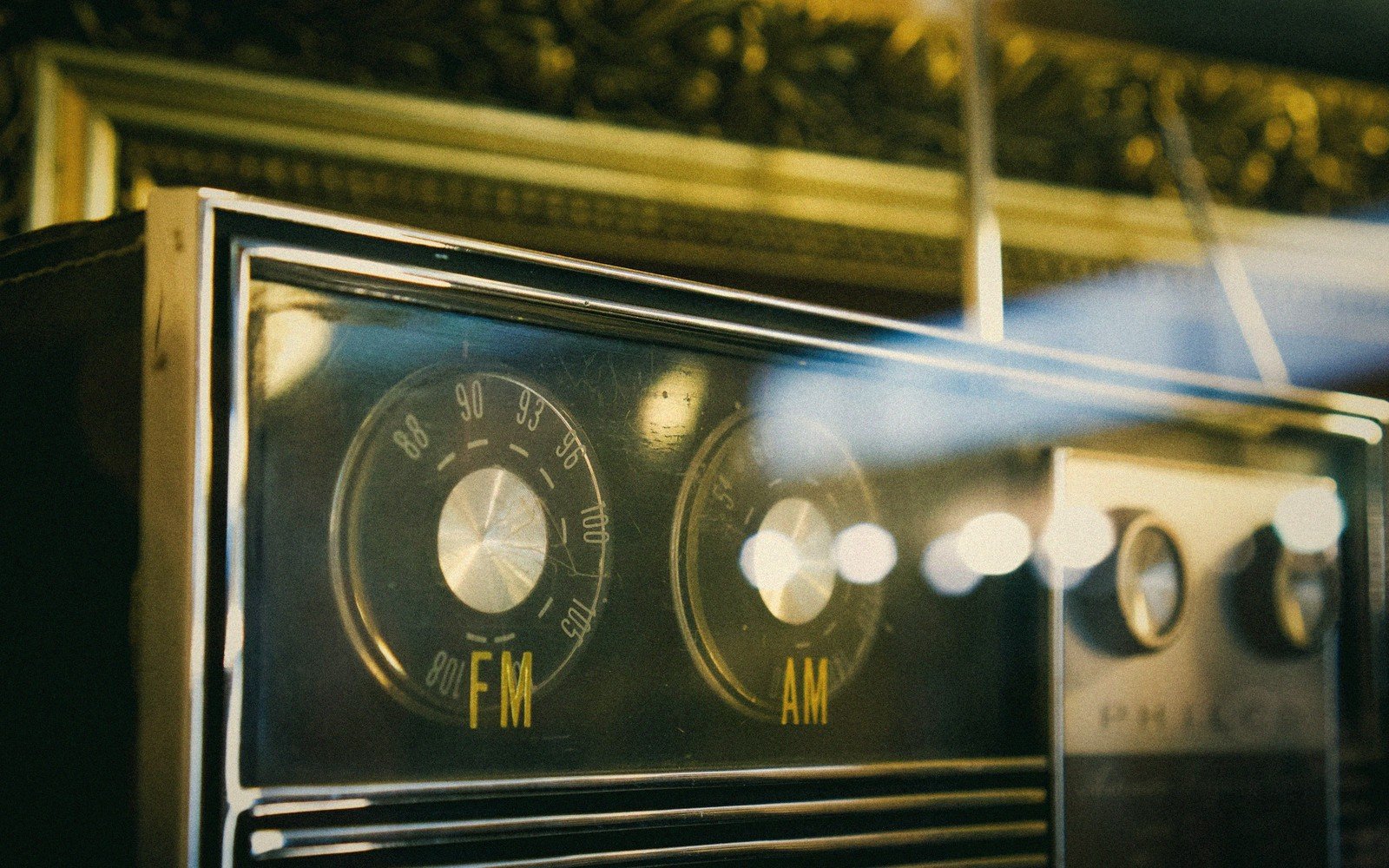
There is no single correct way to send audio through the air. AM, FM and digital radio are each solutions to the same problem — get a signal from a transmitter to a listener — and each makes a different set of compromises. Understanding those trade-offs explains a great deal about why radio sounds the way it does, and why the same station can seem like a different medium depending on how you receive it.
01Amplitude Modulation: the long-distance bargain
AM encodes audio by varying the strength — the amplitude — of a carrier wave. The carrier sits at a fixed frequency in the medium-wave band (roughly 530–1700 kHz in most of the world) or, for international broadcasting, the shortwave bands above that. Because these long wavelengths diffract around terrain and, at night, bounce off the ionosphere, a single AM transmitter can cover enormous distances. That ground-wave and sky-wave behaviour is why, historically, AM was the backbone of national networks and why a medium-wave signal from one country can be heard on the other side of a continent after dark.
The cost is fidelity. AM's usable audio bandwidth is narrow — typically 4–5 kHz at most, which rolls off the high frequencies that give music its shimmer and air. More damaging still, anything that varies the strength of the signal — electrical interference, weather, nearby machinery — registers directly as noise, because amplitude variation is exactly what AM uses to carry audio. The result is the characteristic crackle and hiss that defines the band. AM is durable and far-reaching; it is not high-fidelity.
02Frequency Modulation: the quality trade
FM encodes audio by varying the frequency of the carrier — nudging it slightly above and below its nominal position in the VHF band (87.5–108 MHz in most regions) at a rate that mirrors the audio waveform. Because interference tends to affect amplitude rather than frequency, FM is inherently more resistant to electrical noise. Receivers also exploit a property called capture effect: when two signals occupy the same frequency, the stronger one dominates almost completely, which means a local FM transmitter will simply override distant interference rather than blending with it.
Coverage is local or regional by nature, not continental.
The audio quality reward is substantial. A standard FM broadcast occupies up to 200 kHz of spectrum and can carry audio bandwidth of up to 15 kHz per channel — well beyond what AM can manage — with stereo encoded in the same signal using a subcarrier system standardised in the early 1960s. That combination of low noise and genuine stereo made FM the dominant format for music broadcasting from the 1970s onward. The trade-off is reach. VHF signals travel in largely straight lines; they do not bounce off the ionosphere, and they struggle over hills. Coverage is local or regional by nature, not continental. Engineers compensate with transmitter networks and relay stations, but the physics imposes a ceiling.
03Digital: clean until it isn't
Digital radio — whether DAB (Digital Audio Broadcasting, the dominant standard across much of Europe and Australia) or the HD Radio system used in the United States — converts audio to a stream of binary data, protects it with error-correction coding, and transmits it as a modulated digital signal. Within its coverage area, a digital receiver reconstructs the original data and the audio is clean: no crackle, no multipath flutter, no analogue noise floor. Digital also allows a single broadcast multiplex to carry several stations simultaneously in the spectrum one analogue station would occupy, plus data services such as scrolling programme information.
The failure mode, though, is abrupt. Analogue signals degrade gracefully — FM goes from clear to slightly hissy to distorted as you move away from the transmitter. Digital signals hold perfect until the error-correction is overwhelmed, at which point audio breaks into characteristic glitches, stutters and dropouts, then disappears entirely. Listeners near a coverage boundary experience this as maddening unreliability that analogue, for all its noise, never quite matches. Indoor reception with a modest aerial can expose the same weakness.